$54.99
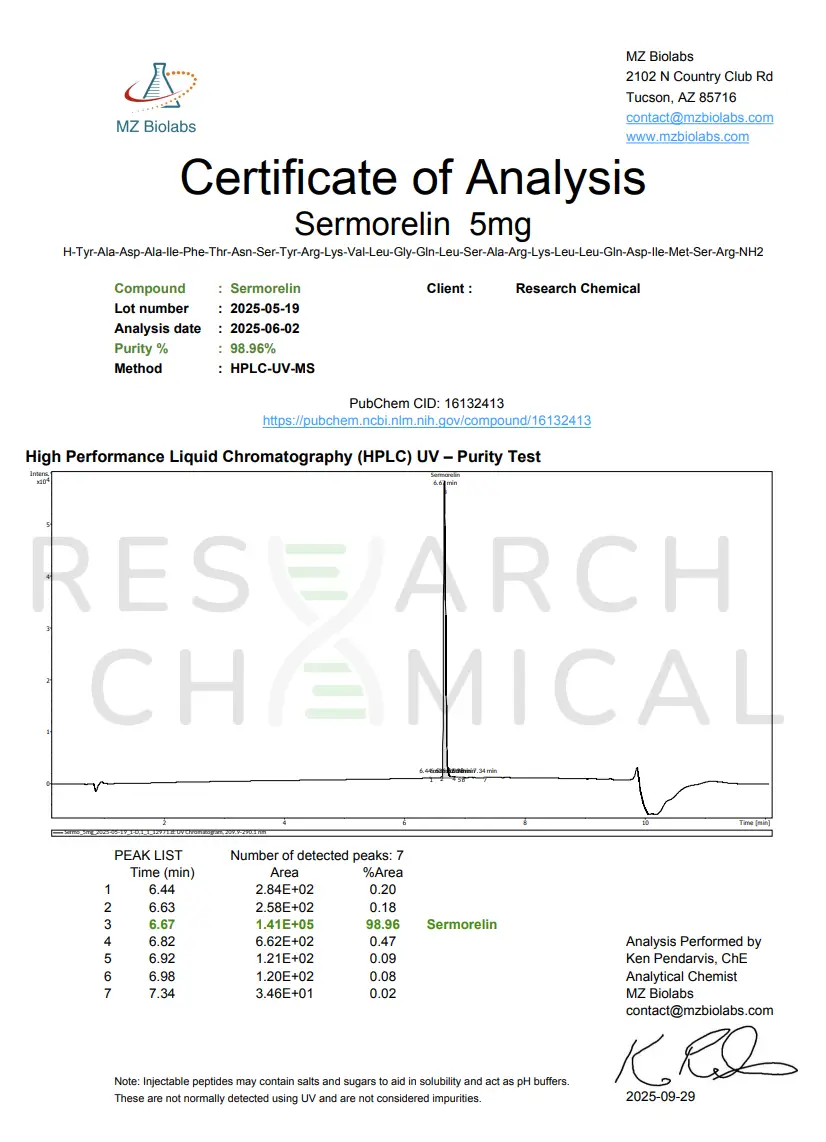
This item has been third-party tested by accredited U.S. laboratories and confirmed to meet a minimum purity of 98% through rigorous verification standards.
Sermorelin is examined in research settings as a synthetic analog of endogenous GHRH, typically corresponding to the first 29 amino acids of the native hormone. Research involving Sermorelin focuses on ligand–receptor binding behavior, receptor-mediated signal initiation, and downstream endocrine signaling pathways under controlled laboratory conditions.
$54.99
Synthetic Growth Hormone–Releasing Hormone (GHRH) Analog
Sermorelin is a synthetic peptide supplied exclusively for laboratory and analytical research purposes. This compound is studied in controlled research environments for its interaction with growth hormone–releasing hormone (GHRH) receptors and its role in hypothalamic–pituitary signaling research models.
Each batch of Sermorelin is independently third-party tested to verify identity and purity, supporting accuracy and reproducibility in scientific research applications.
Sermorelin is studied in laboratory and preclinical research environments to better understand GHRH-mediated signaling within endocrine regulatory systems. Researchers examine this compound to explore:
As a truncated and well-defined peptide analog, Sermorelin allows researchers to investigate receptor signaling behavior with precise experimental control.
In experimental models, Sermorelin interacts with GHRH receptors located on pituitary somatotroph cells, initiating intracellular signaling cascades associated with receptor activation. Research focuses on signal transduction pathways, regulatory feedback mechanisms, and transcriptional coordination within endocrine signaling systems.
These investigations are mechanistic and exploratory and do not imply physiological, therapeutic, or performance-related outcomes.
Sermorelin supplied by ResearchChemical.com is produced under controlled peptide synthesis conditions to support compound integrity, purity, and reproducibility.
Manufacturing and verification standards include:
These measures ensure transparency and reliability for laboratory research use.
Laboratory supplies and dilution solutions are not included.
Research Chemical products are third-party tested by MZ Biolabs, an independent laboratory based in Arizona. Each batch is analyzed to ensure accuracy, purity, and that all specifications are met.

Store Sermorelin in a cool, dry environment away from direct light. Refrigerate after reconstitution, if applicable, to maintain peptide stability. Avoid repeated freeze-thaw cycles and follow standard laboratory handling protocols to prevent contamination or degradation.
By purchasing from ResearchChemical.com, you acknowledge that you are acquiring research chemicals intended solely for scientific investigation.
Sermorelin is:
The information provided on this page is for educational and informational purposes only and should not be interpreted as medical advice. ResearchChemical.com assumes no liability for misuse, improper handling, or use outside of controlled research environments. It is the purchaser’s responsibility to ensure compliance with all applicable laws and regulations.
Sermorelin has a similar effect to growth hormone-releasing hormone (GHRH) in the body. It stimulates the pituitary gland to produce and regulate levels of growth hormone, which is essential for proper bodily development.
In the United States, Sermorelin is legal.
Sermorelin is being studied for its effect on muscle and fat metabolism. However, its effectiveness in preventing aging lacks conclusive evidence from studies. Thus, the choice to research Sermorelin should be based on desired research outcomes.
Sermorelin works by promoting the body’s natural production of growth hormone, which is beneficial for addressing issues such as a deficiency in this essential hormone. It can also aid in metabolism such as the ability to reduce fat mass while increasing muscle mass. Essentially, it supports overall bodily growth and development through regulating levels of growth hormone.
Lorem ipsum dolor sit amet, consectetur adipiscing elit. Ut elit tellus, luctus nec ullamcorper mattis, pulvinar dapibus leo.
Research Chemical products are third-party tested by MZ Biolabs, an independent laboratory based in Arizona. Each batch is analyzed to ensure accuracy, purity, and that all specifications are met.

By purchasing from ResearchChemical.com, you acknowledge that you are acquiring research chemicals intended solely for scientific investigation.
Sermorelin is:
The information provided on this page is for educational and informational purposes only and should not be interpreted as medical advice. ResearchChemical.com assumes no liability for misuse, improper handling, or use outside of controlled research environments. It is the purchaser’s responsibility to ensure compliance with all applicable laws and regulations.
1. Walker, R. F. (2006). Sermorelin: A better approach to management of adult-onset growth hormone insufficiency?. Clinical interventions in aging, 1(4), 307-308.
2. Prakash, A., & Goa, K. L. (1999). Sermorelin: a review of its use in the diagnosis and treatment of children with idiopathic growth hormone deficiency. BioDrugs, 12, 139-157.
3. Ishida, J., Saitoh, M., Ebner, N., Springer, J., Anker, S. D., & von Haehling, S. (2020). Growth hormone secretagogues: history, mechanism of action, and clinical development. JCSM Rapid Communications, 3(1), 25-37.
4. FARER, L. J. Sermorelin─ a Superior Approach to Growth Hormone Restoration.
5. Sinha, D. K., Balasubramanian, A., Tatem, A. J., Rivera-Mirabal, J., Yu, J., Kovac, J., … & Lipshultz, L. I. (2020). Beyond the androgen receptor: the role of growth hormone secretagogues in the modern management of body composition in hypogonadal males. Translational andrology and urology, 9(Suppl 2), S149.
6. Chang, Y., Huang, R., Zhai, Y., Huang, L., Feng, Y., Wang, D., … & Hu, H. (2021). A potentially effective drug for patients with recurrent glioma: Sermorelin. Annals of Translational Medicine, 9(5).
7. Walker, R. Growth Hormone Releasing Peptides.
8. Friedman, S. D., Baker, L. D., Borson, S., Jensen, J. E., Barsness, S. M., Craft, S., … & Vitiello, M. V. (2013). Growth Hormone–Releasing Hormone effects on brain γ-Aminobutyric acid levels in mild cognitive impairment and healthy aging. JAMA neurology, 70(7), 883-890.


Join our insider list for the latest research insights, product releases, and special offers—delivered straight to your inbox.