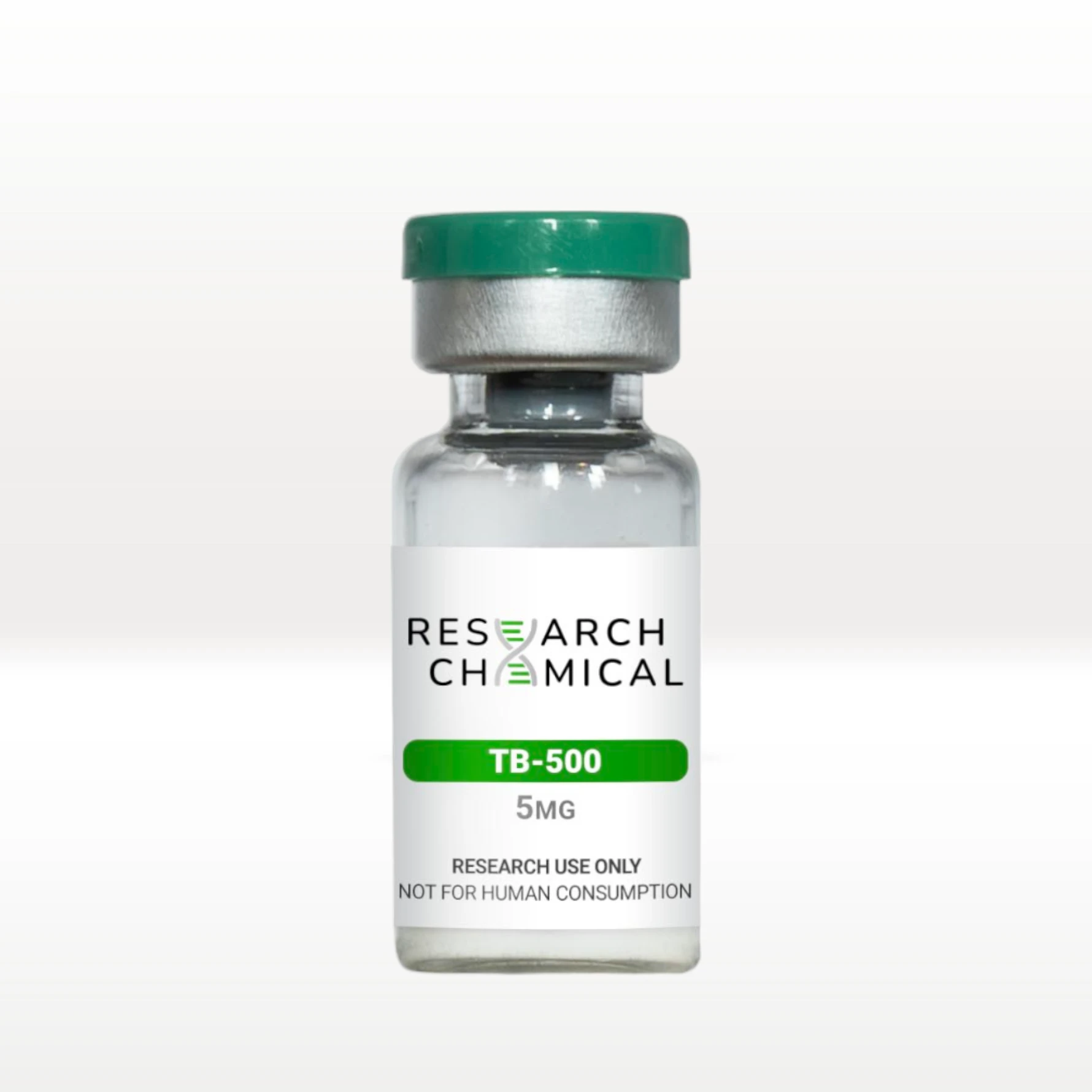
$74.99
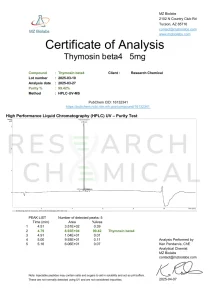
This item has been third-party tested by accredited U.S. laboratories and confirmed to meet a minimum purity of 98% through rigorous verification standards.
TB-500 is studied in laboratory environments for its interaction with actin-related cellular signaling pathways and mechanisms involved in cell migration and structural organization models.
Research interest focuses on how this peptide fragment influences intracellular signaling behavior under controlled experimental conditions. This compound is supplied exclusively for scientific and analytical research use.
$74.99
Synthetic Thymosin Beta-4 Fragment Research Compound
TB-500 is a synthetic peptide supplied exclusively for laboratory and analytical research purposes. This compound is studied in controlled research environments for its role in peptide signaling research, cytoskeletal interaction models, and cellular pathway investigations.
Each batch of TB-500 is independently third-party tested to verify identity and purity, supporting accuracy and reproducibility in scientific research applications.
TB-500 is studied in laboratory and preclinical research environments to better understand how short synthetic peptides interact with intracellular signaling systems. Researchers examine this compound to explore:
As a synthetic research peptide, TB-500 serves as a tool compound for investigating peptide-driven cellular signaling behavior.
In experimental models, TB-500 is examined for its interaction with intracellular proteins and peptide-responsive signaling pathways. Research focuses on signal modulation, intracellular interaction mapping, and cellular response observation within controlled laboratory environments.
These investigations are mechanistic and exploratory and do not imply healing, tissue repair, angiogenesis, injury recovery, or therapeutic outcomes.
This TB-500 peptide supplied by ResearchChemical.com is produced under controlled synthesis conditions and verified per batch to meet stated specifications.
Product-specific attributes include:
TB-500 is studied in laboratory and preclinical environments to better understand actin dynamics and cytoskeletal signaling behavior. Actin plays a fundamental role in cell structure and intracellular transport, making it a key focus area in cellular biology research.
By examining how TB-500 interacts with actin-related pathways, researchers aim to gain insight into cell migration models, intracellular signaling coordination, and structural response mechanisms. These investigations are conducted strictly within controlled experimental systems and do not imply therapeutic application.
A primary area of TB-500 research involves actin sequestration and cytoskeletal organization models. Actin dynamics are central to cellular shape, movement, and internal signaling transport, making them a critical area of study in cell biology.
TB-500 has also been included in research models exploring how cytoskeletal components influence signal transduction efficiency and intracellular communication pathways. These studies help researchers understand the relationship between cellular structure and signaling behavior.
In research environments, TB-500 is typically supplied in lyophilized form, which supports:
Proper storage and handling are essential to maintaining experimental consistency when working with peptide compounds.
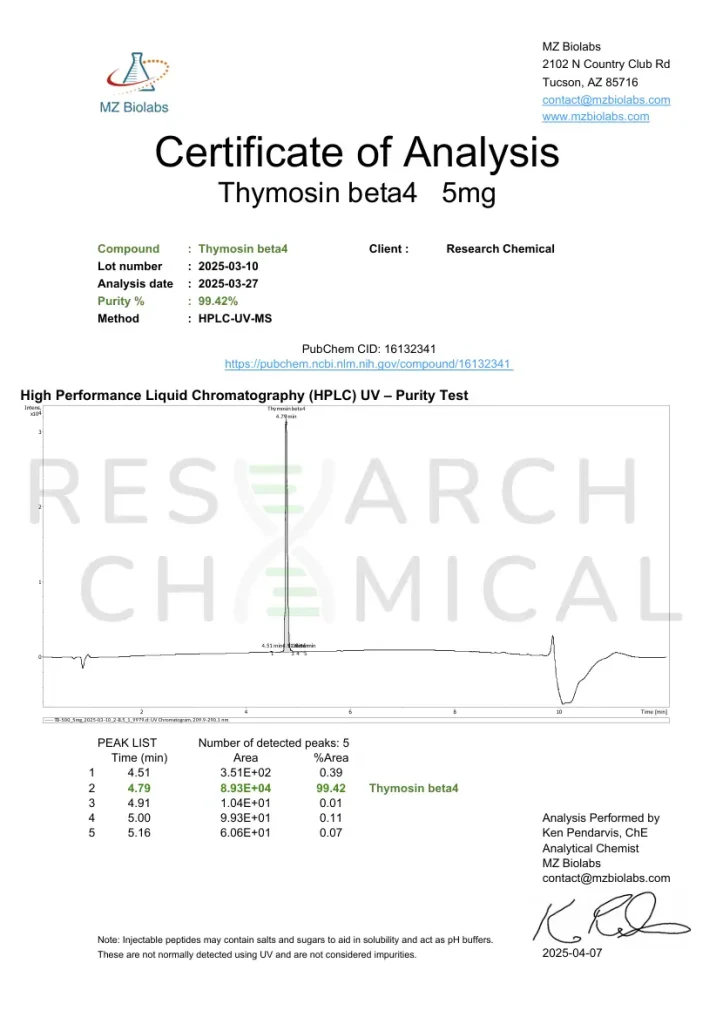
Research Chemical products are third-party tested by MZ Biolabs, an independent laboratory based in Arizona. Each batch is analyzed to ensure accuracy, purity, and that all specifications are met.
Each Certificate of Analysis includes:
By purchasing from ResearchChemical.com, you acknowledge that you are acquiring research chemicals intended solely for scientific investigation.
These products:
ResearchChemical.com assumes no liability for misuse, improper handling, or use outside of controlled laboratory settings.
TB-500, also known as Thymosin Beta 4, is primarily utilized in lab research to investigate its potential in promoting:
TB-500 is also being studied in preclinical settings for its potential relevance to various health conditions, with a focus on supporting the body’s natural healing processes and recovery mechanisms. Ongoing research is exploring TB-500’s potential to modulate pain pathways and inflammatory responses associated with tissue injury, particularly in animal models and in vitro systems.
Researchers are actively studying TB-500 for various medical applications and its role in regenerative medicine and cell differentiation. TB-500 is a research chemical studied for research purposes only. It is not a dietary supplement and is not for human consumption.
TB-500 is utilized in laboratory research to investigate its roles in tissue repair, angiogenesis, cellular migration, inflammation modulation, and blood/endothelial cell behavior. It is not a dietary supplement and is not for human consumption.
Both TB-500 and BPC-157 are subjects of regenerative research. TB-500 acts more systemically, while BPC-157 is studied for localized effects, particularly in the gastrointestinal tract and connective tissues. Their use in research depends on study goals.
In preclinical studies, adverse effects are model-dependent. Reported issues in non-regulated use include headaches, fatigue, dizziness, nausea, and injection site irritation. These are not clinical safety data.
TB-500 has shown potential in supporting muscle growth and recovery in research, however, further studies are needed to fully understand its effects on muscle development in humans including its effects on recovery such as wound healing.
Lyophilization supports peptide stability and accurate preparation in laboratory research environments.
Lorem ipsum dolor sit amet, consectetur adipiscing elit. Ut elit tellus, luctus nec ullamcorper mattis, pulvinar dapibus leo.
Research Chemical products are third-party tested by MZ Biolabs, an independent laboratory based in Arizona. Each batch is analyzed to ensure accuracy, purity, and that all specifications are met.
Each Certificate of Analysis includes:
By purchasing from ResearchChemical.com, you acknowledge that you are acquiring research chemicals intended solely for scientific investigation.
These products:
ResearchChemical.com assumes no liability for misuse, improper handling, or use outside of controlled laboratory settings.
1. Goldstein AL, Hannappel E, Kleinman HK. Thymosin beta4: actin-sequestering protein moonlights to repair injured tissues. Trends in Molecular Medicine. 2005 Aug;11(8): 354-61.
2. Post A, Al-Rawi M, Sumitran-Holgersson S. In vivo tissue repair activity of thymosin beta-4 in wound healing. Annals of the New York Academy of Sciences. 2007 Sep;1112: 177-81. doi: 10.1196/annals.1415.019.
3. Hinkel, R., El-Aouni, C., Olson, T., Horstkotte, J., Mayer, S., Müller, S., … & Kupatt, C. (2008). Thymosin β4 is an essential paracrine factor of embryonic endothelial progenitor cell–mediated cardioprotection. Circulation, 117(17), 2232-2240.
4. Belsky, J. B., Rivers, E. P., Filbin, M. R., Lee, P. J., & Morris, D. C. (2018). Thymosin beta 4 regulation of actin in sepsis. Expert opinion on biological therapy, 18(sup1), 193-197.
5. Bock-Marquette I, Saxena A, White MD, et al. Thymosin beta4 activates integrin-linked kinase and promotes cardiac cell migration, survival and cardiac repair. Nature. 2004 Apr;432(7016): 466-72. doi: 10.1038/nature03000.
6. Goldstein, A. L., Hannappel, E., Sosne, G., & Kleinman, H. K. (2012). Thymosin β4: a multi-functional regenerative peptide. Basic properties and clinical applications. Expert opinion on biological therapy, 12(1), 37-51.
7. Sosne, G., Rimmer, D., Kleinman, H. K., & Ousler, G. (2016). Thymosin beta 4: a potential novel therapy for neurotrophic keratopathy, dry eye, and ocular surface diseases. Vitamins and hormones, 102, 277-306.
8. Smart, N., Risebro, C. A., Melville, A. A., Moses, K., Schwartz, R. J., Chien, K. R., & Riley, P. R. (2007). Thymosin β4 induces adult epicardial progenitor mobilization and neovascularization. Nature, 445(7124), 177-182.
Join our insider list for the latest research insights, product releases, and special offers—delivered straight to your inbox.