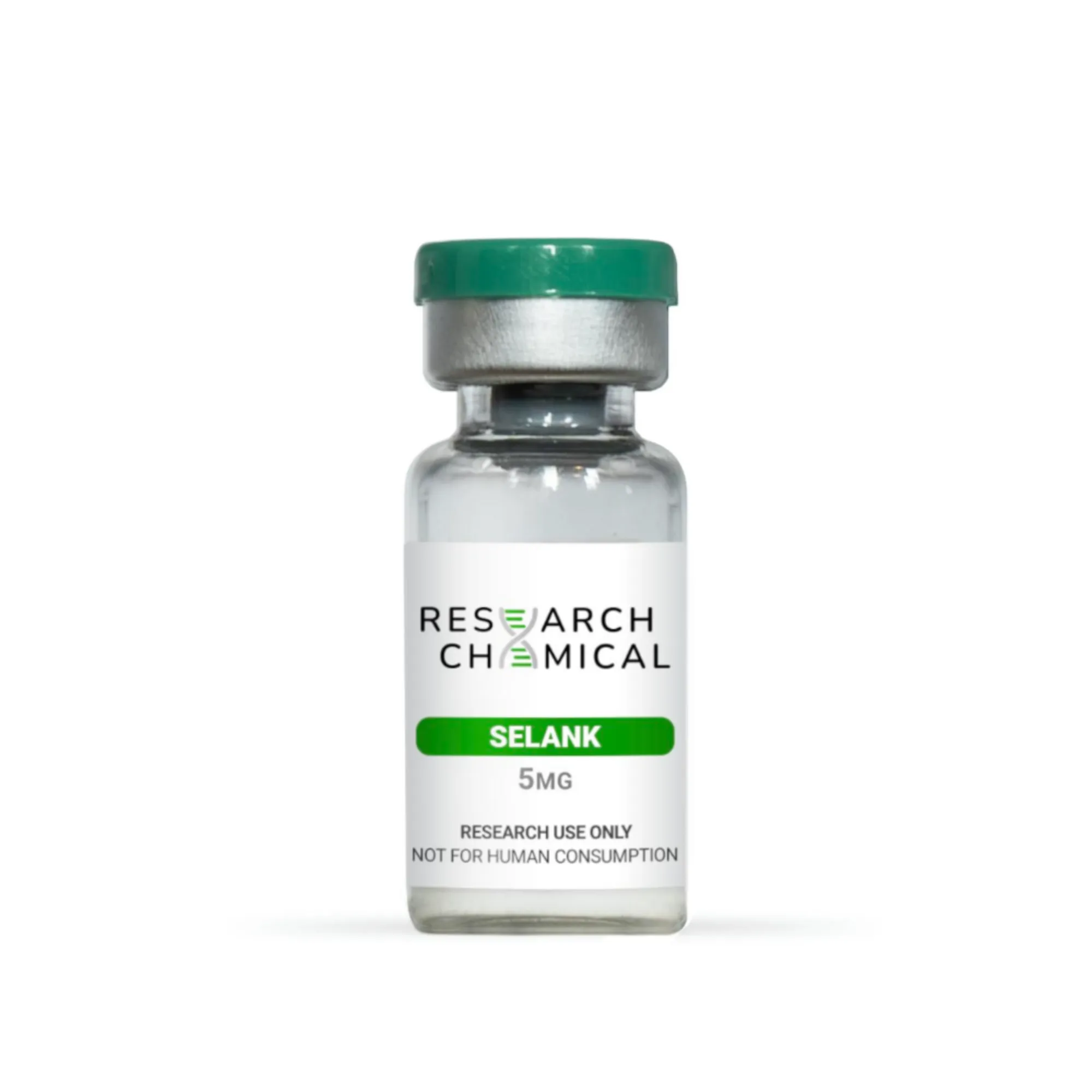
| Compound Class | Synthetic Regulatory Neuropeptide (Tuftsin Analog) |
|---|---|
| Form | Lyophilized powder, sterile glass vial |
| Amount per Vial | 5 mg |
| Sequence | Thr-Lys-Pro-Arg-Pro-Gly-Pro |
| CAS Number | 129954-34-3 |
| Chemical Formula | C33H57N11O9 |
| Molar Mass | 751.9 g/mol |
| Synonyms | Selank, TP-7 |
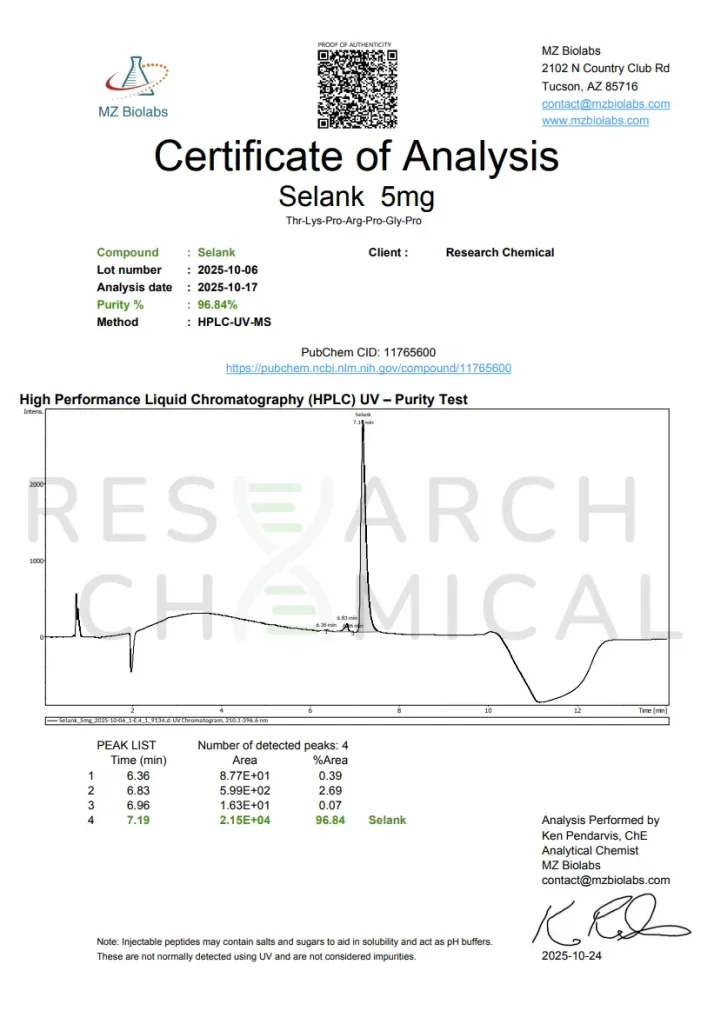
| Verified Purity | Batch-tested to 98% (HPLC) |
For laboratory research use only. Not for human or animal consumption.
Each peptide batch is analyzed by an accredited third-party laboratory before it ships.
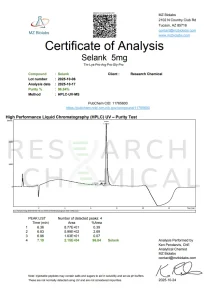
Most recent batch certificate of analysis, issued by MZ Biolabs. Click to view full size on the certificates page.
Lorem ipsum dolor sit amet, consectetur adipiscing elit. Ut elit tellus, luctus nec ullamcorper mattis, pulvinar dapibus leo.
Research Chemical products are third-party tested by MZ Biolabs, an independent laboratory based in Arizona. Each batch is analyzed to ensure accuracy, purity, and that all specifications are met.
By purchasing from ResearchChemical.com, you acknowledge that you are acquiring research chemicals intended solely for scientific investigation.
Selank is:
The information provided on this page is for educational and informational purposes only and should not be interpreted as medical advice. ResearchChemical.com assumes no liability for misuse, improper handling, or use outside of controlled research environments. It is the purchaser’s responsibility to ensure compliance with all applicable laws and regulations.
1. Peregud, D. I., Baronets, V. Y., Terebilina, N. N., & Gulyaeva, N. V. (2023). Role of BDNF in neuroplasticity associated with alcohol dependence. Biochemistry (Moscow), 88(3), 404-416.
2. Gudasheva, T. A. (2015). Theoretical grounds and technologies for dipeptide drug development. Russian Chemical Bulletin, 64(9), 2012-2021.
3. Kozlovskii, I. I., & Danchev, N. D. (2003). The optimizing action of the synthetic peptide Selank on a conditioned active avoidance reflex in rats. Neuroscience and Behavioral Physiology, 33, 639-643.
4. Zolotarev, Y. A., Kovalev, G. I., Kost, N. V., Voevodina, M. E., Sokolov, O. Y., Dadayan, A. K., … & Myasoedov, N. F. (2016). Anxiolytic activity of the neuroprotective peptide HLDF-6 and its effects on brain neurotransmitter systems in BALB/c and C57BL/6 mice. Journal of Psychopharmacology, 30(9), 922-935.
5. Povarov, I. S., Kondratenko, R. V., Derevyagin, V. I., Myasoedov, N. F., & Skrebitsky, V. G. (2017). Effect of selank on spontaneous synaptic activity of rat hippocampal CA1 neurons. Bulletin of experimental biology and medicine, 162(5), 640.
6. Filatova, E., Kasian, A., Kolomin, T., Rybalkina, E., Alieva, A., Andreeva, L., … & Shadrina, M. (2017). GABA, Selank, and olanzapine affect the expression of genes involved in GABAergic neurotransmission in IMR-32 Cells. Frontiers in Pharmacology, 8, 89.
7. Koroleva, S. V., & Mjasoedov, N. F. (2019). Physiological effects of Selank and its fragments. Biology Bulletin, 46(4), 407-414.
8. Samotrueva, M., Yasenyavskaya, A., Myasoedov, N., & Andreeva, L. RePResentAtIVes oF neURoPePtIDes—seLAnK AnD PRo-GLY-PRo-LeU As MoDULAtoRs oF IMMUnoReACtIVItY In ConDItIons oF” soCIAL” stRess. pharmacology, 3, 5.
9. Medvedev, V. E., Tereshchenko, O. N., AIu, I., Chobanu, I. K., Kost, N. V., & Miasoedov, N. F. (2014). A comparison of the anxiolytic effect and tolerability of selank and phenazepam in the treatment of anxiety disorders. Zhurnal Nevrologii i Psikhiatrii Imeni SS Korsakova, 114(7), 17-22.
10. Slominsky, P. A., Shadrina, M. I., Kolomin, T. A., Stavrovskaya, A. V., Filatova, E. V., Andreeva, L. A., … & Myasoedov, N. F. (2017, May). Peptides semax and selank affect the behavior of rats with 6-OHDA induced PD-like parkinsonism. In Doklady Biological Sciences (Vol. 474, pp. 106-109). Pleiades Publishing.
11. Monica Shetty, K. P. L. (2017). Study of Anxiolytic Activity in Mice Using Vacha Churnam (Rasayana Preparation-Ayurvedic System of Medicine) (Doctoral dissertation, CL Baid Metha College of Pharmacy, Chennai).
12. Zolotarev, Y. A., Sokolov, O. Y., Kost, N. V., Vaskovsky, B. V., Myasoedov, N. F., & Zozulya, A. A. (2004). Leu-enkephalin generally labeled with tritium in studying the Selank inhibiting effect on the enkephalin-degrading enzymes of human blood plasma. Russian Journal of Bioorganic Chemistry, 30, 207-212.
13. Mikhailova, N. A., Voevodin, D. A., & Lazarev, S. A. (2020). A modern view of pro-/eukaryote interactions in the human body as the basis for development of next-generation probiotics. Journal of microbiology, epidemiology and immunobiology, 97(4), 346-355.
Please note that the above references provide evidence for the potential benefits of Selank Peptide as stated in the product description. For more in-depth information, kindly refer to these scholarly works.