$49.99
This item has been third-party tested by accredited U.S. laboratories and confirmed to meet a minimum purity of 98% through rigorous verification standards.
$49.99
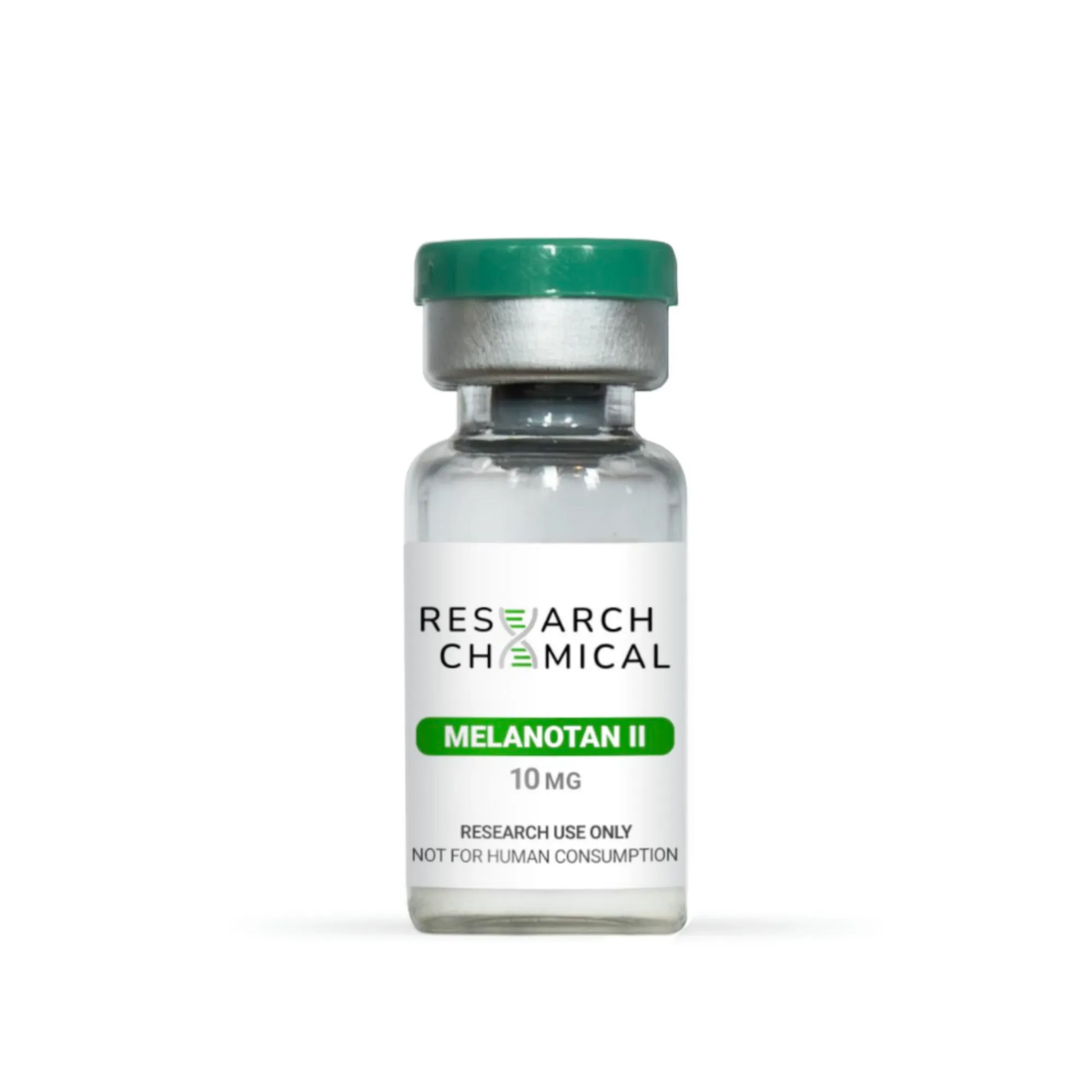
Synthetic cyclic peptide analog of α-melanocyte-stimulating hormone (melanocortin receptor agonist) — lyophilized powder. Supplied by Research Chemical exclusively for laboratory research use.
Lyophilized powder, sterile glass vial.
Independently analyzed by an accredited third-party lab.
7-amino-acid cyclic α-MSH analog, confirmed by mass spectrometry
Supplied exclusively for laboratory investigation.
| Compound Class | Cyclic Melanocortin Receptor Agonist (α-MSH Analog) |
|---|---|
| Form | Lyophilized powder, sterile glass vial |
| Amount per Vial | 10 mg |
| Sequence | Ac-Nle-cyclo[Asp-His-D-Phe-Arg-Trp-Lys]-NH2 |
| CAS Number | 121062-08-6 |
| Chemical Formula | C50H69N15O9 |
| Molar Mass | 1024.2 g/mol |
| Synonyms | Melanotan II, Melanotan-2, MT-II, MT2 |
| Verified Purity | Batch-tested to 98% (HPLC) |
For laboratory research use only. Not for human or animal consumption.
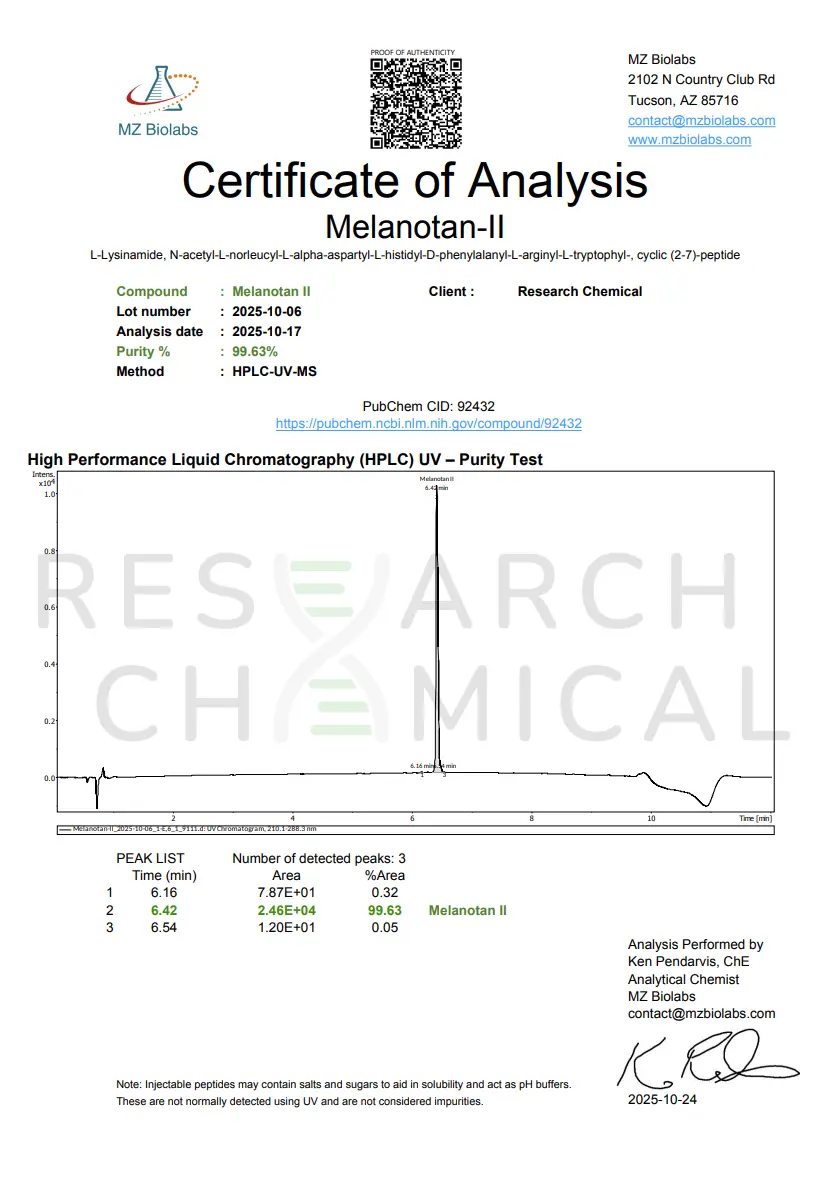
Each peptide batch is analyzed by an accredited third-party laboratory before it ships.
Most recent batch certificate of analysis, issued by MZ Biolabs. Click to view full size on the certificates page.
Every batch sold by Research Chemical is independently analyzed before it ships.
This product is an investigational compound and is not a drug, food, dietary supplement, or cosmetic. It is not approved for human or animal use, and it is unlawful to market it for that purpose.
Melanotan II is not a growth hormone or growth factor and does not carry the WADA S2 classification applied to your other research peptides.
Research Chemical makes no representations regarding the safety or effects of this compound in humans or animals.
Research Chemical is a chemical supplier, not a medical provider. We do not condone or encourage consumer use of research compounds.
Research use only. All products sold by Research Chemical are intended exclusively for laboratory research and development. They are not for human or animal consumption. These statements have not been evaluated by the U.S. Food and Drug Administration, and these products are not intended to diagnose, treat, cure, or prevent any disease.
Lorem ipsum dolor sit amet, consectetur adipiscing elit. Ut elit tellus, luctus nec ullamcorper mattis, pulvinar dapibus leo.
Research Chemical products are third-party tested by MZ Biolabs, an independent laboratory based in Arizona. Each batch is analyzed to ensure accuracy, purity, and that all specifications are met.

By purchasing from ResearchChemical.com, you acknowledge that you are acquiring research chemicals intended solely for scientific investigation.
Melanotan II is:
The information provided on this website is for educational and informational purposes only and should not be interpreted as medical advice. ResearchChemical.com assumes no liability for misuse, improper handling, or use outside of controlled research environments. It is the purchaser’s responsibility to ensure compliance with all applicable laws and regulations.
2. Kublaoui, B. M., Holder Jr, J. L., Gemelli, T., & Zinn, A. R. (2006). Sim1 haploinsufficiency impairs melanocortin-mediated anorexia and activation of paraventricular nucleus neurons. Molecular Endocrinology, 20(10), 2483-2492.
3. Mubashshir, M., Ahmad, N., Sköld, H. N., & Ovais, M. (2023). An exclusive review of melatonin effects on mammalian melanocytes and melanoma. Experimental Dermatology, 32(4), 324-330.
4. Voisey, J., Carroll, L., & Van Daal, A. (2003). Melanocortins and their receptors and antagonists. Current drug targets, 4, 586-597.
5. Abdel-Malek, Z. A. (2001). Melanocortin receptors: their functions and regulation by physiological agonists and antagonists. Cellular and Molecular Life Sciences CMLS, 58, 434-441.
6. Hadley, M. E., Heward, C. B., Hruby, V. I., Sawyer, T. K., & Yang, Y. C. (1981, January). Biological actions of melanocyte‐stimulating hormone. In Ciba Foundation Symposium 81‐Peptides of the Pars Intermedia (Vol. 81, pp. 244-262). Chichester, UK: John Wiley & Sons, Ltd.
7. Rössler, A. S., Pfaus, J. G., Kia, H. K., Bernabé, J., Alexandre, L., & Giuliano, F. (2006). The melanocortin agonist, melanotan II, enhances proceptive sexual behaviors in the female rat. Pharmacology Biochemistry and Behavior, 85(3), 514-521.
8. Nasr, A., Lauterio, T. J., & Davis, M. W. (2011). Unapproved drugs in the United States and the Food and Drug Administration. Advances in therapy, 28, 842-856.
9. Caruso, C., Carniglia, L., Durand, D., Gonzalez, P. V., Scimonelli, T. N., & Lasaga, M. (2012). Melanocortin 4 receptor activation induces brain-derived neurotrophic factor expression in rat astrocytes through cyclic AMP–Protein kinase A pathway. Molecular and cellular endocrinology, 348(1), 47-54.
10. Dorr, R. T., Ertl, G., Levine, N., Brooks, C., Bangert, J. L., Powell, M. B., … & Alberts, D. S. (2004). Effects of a superpotent melanotropic peptide in combination with solar UV radiation on tanning of the skin in human volunteers. Archives of dermatology, 140(7), 827-835.
11. MacNeil, D. J., Howard, A. D., Guan, X., Fong, T. M., Nargund, R. P., Bednarek, M. A., … & Van der Ploeg, L. H. (2002). The role of melanocortins in body weight regulation: opportunities for the treatment of obesity. European journal of pharmacology, 450(1), 93-109.
Please note that the above references provide evidence for the potential benefits of Melanotan 2 Peptide as stated in the product description. For more in-depth information, kindly refer to these scholarly works.


Join our insider list for the latest research insights, product releases, and special offers—delivered straight to your inbox.