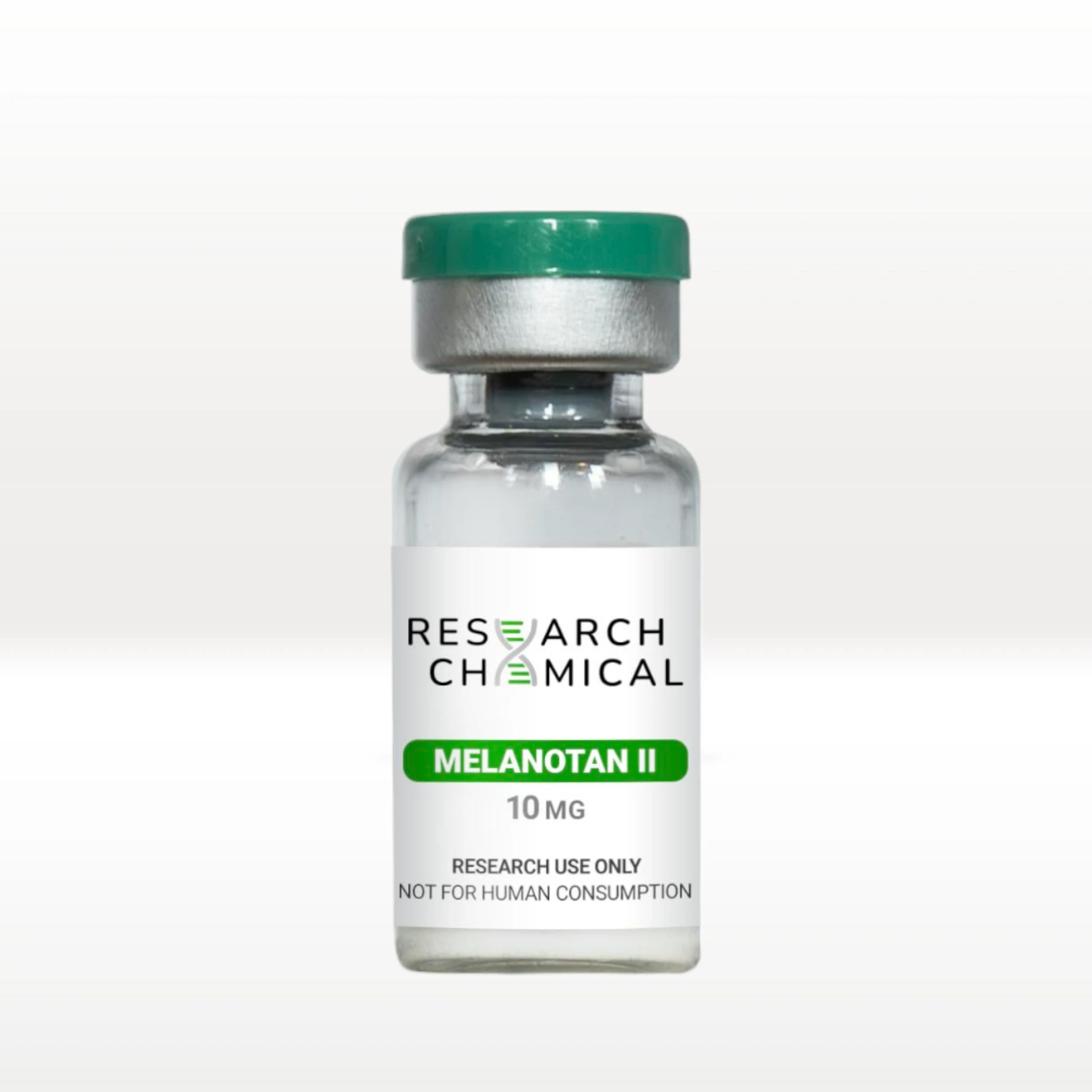
$49.99
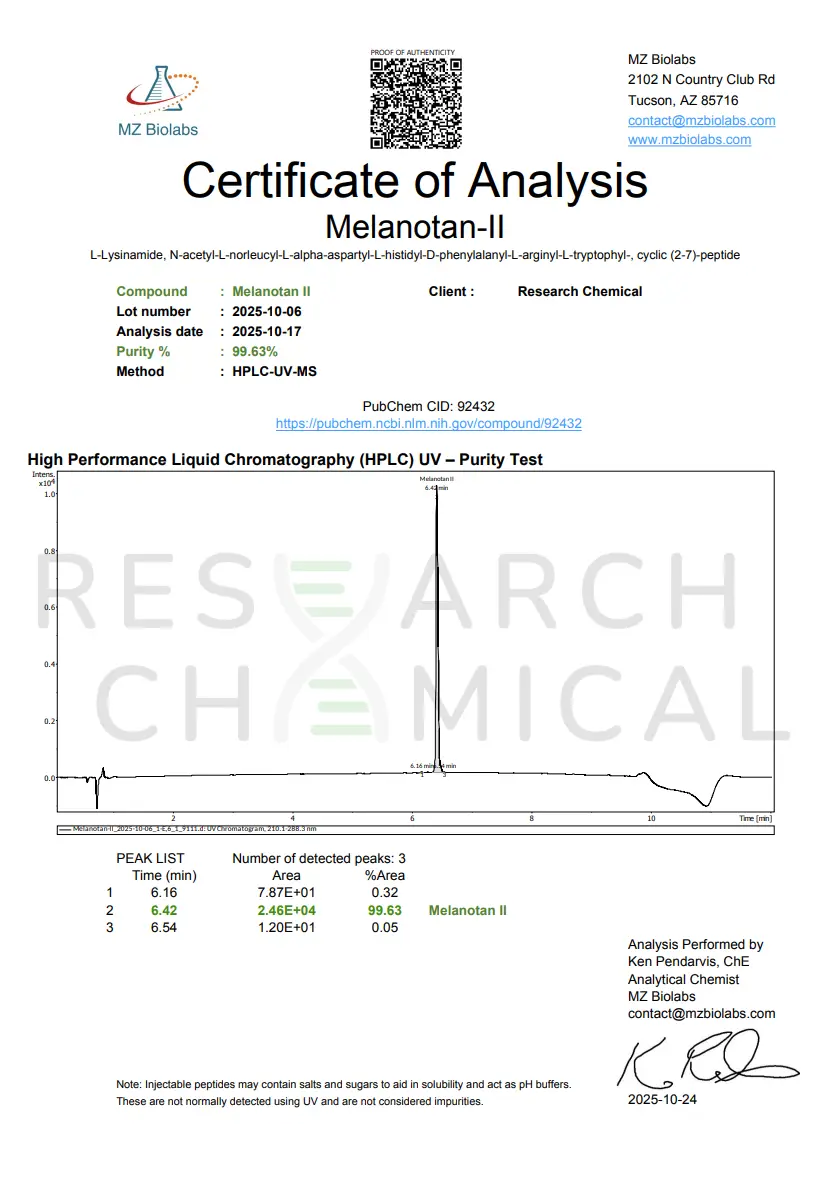
This item has been third-party tested by accredited U.S. laboratories and confirmed to meet a minimum purity of 98% through rigorous verification standards.
Melanotan II is examined in research settings as a melanocortin receptor agonist, interacting primarily with MC1R, MC3R, MC4R, and MC5R receptor subtypes.
Research involving Melanotan II focuses on peptide–receptor binding behavior, receptor selectivity, and downstream signaling pathways under controlled experimental conditions.
$49.99
Melanotan II is a synthetic peptide analog studied in laboratory and preclinical research environments for its interaction with melanocortin receptors, a family of G protein–coupled receptors involved in neuroendocrine and cellular signaling systems. Research involving Melanotan II focuses on peptide–receptor binding behavior, receptor subtype selectivity, and downstream signaling mechanisms under controlled experimental conditions.
Each batch of Melanotan II is independently third-party tested to verify identity and purity, ensuring consistency and reliability for scientific research applications.
For research use only. Not for human or veterinary use.
Melanocortin receptors (MC1R–MC5R) are part of the GPCR superfamily and play roles in a wide range of intracellular signaling processes. In research settings, melanocortin receptor signaling is studied to better understand:
Synthetic melanocortin analogs such as Melanotan II are used in research to help isolate and examine receptor-specific signaling behavior across different experimental models.
In laboratory models, Melanotan II binds to melanocortin receptors and activates GPCR-mediated signaling pathways. Upon receptor engagement, intracellular signaling events may include:
Research involving melanocortin receptor activation focuses on signal initiation, amplification, and modulation, rather than on physiological outcomes.
In research environments, Melanotan II is typically supplied in lyophilized peptide form, supporting:
Adherence to proper storage and handling protocols is essential for maintaining peptide integrity and ensuring reproducibility in laboratory research.
Melanotan II is a cyclic synthetic peptide designed to interact with melanocortin receptor subtypes. Its peptide structure includes modifications that influence receptor affinity, signaling duration, and stability in experimental environments.
From a molecular research perspective, Melanotan II is examined for:
These characteristics make it a useful compound for exploring structure–function relationships within the melanocortin system.
Laboratory supplies and dilution solutions are not included.
Research Chemical products are third-party tested by MZ Biolabs, an independent laboratory based in Arizona. Each batch is analyzed to ensure accuracy, purity, and that all specifications are met.
Store Melanotan II in a cool, dry environment away from direct light. Refrigerate after reconstitution, if applicable, to maintain peptide stability.
Avoid repeated freeze-thaw cycles and follow standard laboratory handling protocols to prevent contamination or degradation.
By purchasing from ResearchChemical.com, you acknowledge that you are acquiring research chemicals intended solely for scientific investigation.
Melanotan II is:
The information provided on this website is for educational and informational purposes only and should not be interpreted as medical advice. ResearchChemical.com assumes no liability for misuse, improper handling, or use outside of controlled research environments. It is the purchaser’s responsibility to ensure compliance with all applicable laws and regulations.
Melanotan 2 (MT2) is a peptide that interacts with melanocortin receptors in the central nervous system, primarily targeting melanocyte stimulation. It is known for its potential to induce skin pigmentation, leading to a tanning effect, and may also have implications in appetite regulation and food intake, along with sexual behavior that are currently all under study.
Melanotan 2 has been studied for its potential impact on energy homeostasis, appetite regulation, and hunger behavior, which could have implications for body weight. However, research is ongoing, and further clinical trials are needed to establish a direct correlation between melanotan 2 and weight loss.
Yes, studies have stated that Melanotan 2 can induce skin pigmentation without sunbeds, but exposure to ultraviolet light may enhance the tanning effect.
The worst side effects reported by studies thus far of Melanotan 2 include potential adverse effects on cardiovascular health and the central nervous system, such as increased blood pressure and nausea.
Melanotan 2 is not FDA approved and is exclusively sold for research purposes. It is not intended for human consumption or use and is only available for laboratory research.
Lorem ipsum dolor sit amet, consectetur adipiscing elit. Ut elit tellus, luctus nec ullamcorper mattis, pulvinar dapibus leo.
Research Chemical products are third-party tested by MZ Biolabs, an independent laboratory based in Arizona. Each batch is analyzed to ensure accuracy, purity, and that all specifications are met.
By purchasing from ResearchChemical.com, you acknowledge that you are acquiring research chemicals intended solely for scientific investigation.
Melanotan II is:
The information provided on this website is for educational and informational purposes only and should not be interpreted as medical advice. ResearchChemical.com assumes no liability for misuse, improper handling, or use outside of controlled research environments. It is the purchaser’s responsibility to ensure compliance with all applicable laws and regulations.
2. Kublaoui, B. M., Holder Jr, J. L., Gemelli, T., & Zinn, A. R. (2006). Sim1 haploinsufficiency impairs melanocortin-mediated anorexia and activation of paraventricular nucleus neurons. Molecular Endocrinology, 20(10), 2483-2492.
3. Mubashshir, M., Ahmad, N., Sköld, H. N., & Ovais, M. (2023). An exclusive review of melatonin effects on mammalian melanocytes and melanoma. Experimental Dermatology, 32(4), 324-330.
4. Voisey, J., Carroll, L., & Van Daal, A. (2003). Melanocortins and their receptors and antagonists. Current drug targets, 4, 586-597.
5. Abdel-Malek, Z. A. (2001). Melanocortin receptors: their functions and regulation by physiological agonists and antagonists. Cellular and Molecular Life Sciences CMLS, 58, 434-441.
6. Hadley, M. E., Heward, C. B., Hruby, V. I., Sawyer, T. K., & Yang, Y. C. (1981, January). Biological actions of melanocyte‐stimulating hormone. In Ciba Foundation Symposium 81‐Peptides of the Pars Intermedia (Vol. 81, pp. 244-262). Chichester, UK: John Wiley & Sons, Ltd.
7. Rössler, A. S., Pfaus, J. G., Kia, H. K., Bernabé, J., Alexandre, L., & Giuliano, F. (2006). The melanocortin agonist, melanotan II, enhances proceptive sexual behaviors in the female rat. Pharmacology Biochemistry and Behavior, 85(3), 514-521.
8. Nasr, A., Lauterio, T. J., & Davis, M. W. (2011). Unapproved drugs in the United States and the Food and Drug Administration. Advances in therapy, 28, 842-856.
9. Caruso, C., Carniglia, L., Durand, D., Gonzalez, P. V., Scimonelli, T. N., & Lasaga, M. (2012). Melanocortin 4 receptor activation induces brain-derived neurotrophic factor expression in rat astrocytes through cyclic AMP–Protein kinase A pathway. Molecular and cellular endocrinology, 348(1), 47-54.
10. Dorr, R. T., Ertl, G., Levine, N., Brooks, C., Bangert, J. L., Powell, M. B., … & Alberts, D. S. (2004). Effects of a superpotent melanotropic peptide in combination with solar UV radiation on tanning of the skin in human volunteers. Archives of dermatology, 140(7), 827-835.
11. MacNeil, D. J., Howard, A. D., Guan, X., Fong, T. M., Nargund, R. P., Bednarek, M. A., … & Van der Ploeg, L. H. (2002). The role of melanocortins in body weight regulation: opportunities for the treatment of obesity. European journal of pharmacology, 450(1), 93-109.
Please note that the above references provide evidence for the potential benefits of Melanotan 2 Peptide as stated in the product description. For more in-depth information, kindly refer to these scholarly works.
Join our insider list for the latest research insights, product releases, and special offers—delivered straight to your inbox.