

$54.99
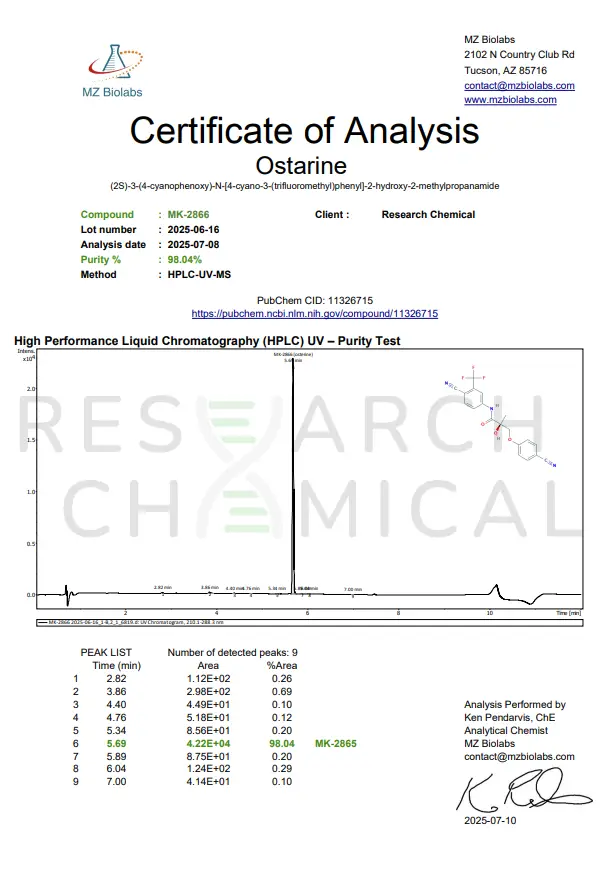
This item has been third-party tested by accredited U.S. laboratories and confirmed to meet a minimum purity of 98% through rigorous verification standards.
Updated COA's
Secure Shipping Guaranteed
Verified for Purity
$54.99
Research Chemical products are third-party tested by MZ Biolabs, an independent laboratory based in Arizona. Each batch is analyzed to ensure accuracy, purity, and that all specifications are met.

At ResearchChemical.com, we provide Liquid Ostarine (MK-2866) with >99% purity for qualified research laboratories. This compound is classified as a selective androgen receptor modulator (SARM) and is not intended for human consumption. Ostarine (MK-2866) is a man-made compound developed by GTx Pharmaceuticals.
Our Liquid Ostarine is designed for laboratory research purposes only, with consistent batch quality, tamper-evident packaging, and precision measuring tools, ensuring safe handling and reliable, repeatable outcomes.
Ostarine has been studied in research settings for its potential effects in:
Muscle wasting and lean mass preservation models
Bone density regulation and skeletal health investigations
Sarcopenia and age-related muscular atrophy models
Evaluating androgen receptor selectivity, the action of Ostarine at the receptor level, and downstream signaling
Ostarine (MK-2866) is a selective androgen receptor modulator (SARM) that has shown anabolic activity in muscle tissue and potential effects on bone, based on preclinical and limited clinical data. In controlled clinical trials, Ostarine increased lean body mass and produced modest improvements in physical function in elderly men and postmenopausal women, populations typically experiencing muscle atrophy.
These studies did not involve structured caloric restriction, but the compound’s effects were observed in catabolic states, suggesting its ability to preserve or increase lean mass under such conditions. While Ostarine’s anabolic mechanism may theoretically support bone and muscle, and lean mass gains have been documented, claims regarding significant fat reduction or dramatic body composition improvements are not supported by current clinical evidence (Dalton, 2011).
SARMs were initially developed to treat medical conditions related to muscle loss, weakness, and bone issues. In ongoing clinical trials, Ostarine was shown to increase lean body mass in catabolic conditions, such as age-related muscle loss. In a 12-week randomized, double-blind, placebo-controlled study, participants received daily doses ranging from 1 mg to 3 mg of Ostarine. The study found dose-dependent gains in lean body mass, even without changes to diet or exercise. Notably, even at the lowest dose, participants experienced measurable increases in lean mass, and starting with a lower dose also appeared to minimize side effects. Participants were monitored for hormonal changes and recovery, with follow-up assessments indicating that post-intervention hormone normalization and muscle retention were achievable (Dalton et al., 2011).
While these effects are sometimes described as occurring “under caloric deficit,” the clinical trial was conducted in non-athletic, elderly populations experiencing muscle atrophy, not in controlled calorie-restriction studies in healthy adults (Dalton et al., 2011).
CAS Number: 841205-47-8
Chemical Formula: C₁₉H₁₄F₃N₃O₃
Molar Mass: 389.33 g/mol
Half-Life: ~24 hours
Classification: Selective androgen receptor modulator (SARM)
Storage Instructions: Store in a cool, dry place away from sunlight for optimal shelf life.
Concentration: 25 mg/mL
Volume: 30 mL
Purity: >99% (Independent third-party verified)
Batch Variance: <5% for consistency across research studies
Packaging: UV-resistant glass bottle with tamper-evident seal
Measuring Tool: 1 mL graduated glass pipette included
Stability: Formulated to resist evaporation and maintain potency
Ostarine (MK-2866) is not a dietary supplement and should not be ingested by humans. It is an investigational drug that has not been approved for human use by the U.S. Food and Drug Administration (FDA). Despite this, Ostarine is sometimes illegally marketed as a dietary supplement for bodybuilding and sold through unregulated channels, which raises significant safety and regulatory concerns for both researchers and regulatory authorities.
The FDA has issued multiple public warnings regarding the dangers of using Ostarine and other SARMs due to potential serious health risks, including liver damage. Ostarine is considered possibly unsafe for human use, and its sale as a supplement violates U.S. law.
Additionally, SARMs—including Ostarine—are prohibited substances under the World Anti-Doping Agency (WADA) Prohibited List and by the National Collegiate Athletic Association (NCAA). Any implication of human use violates STL’s Terms of Service, and our products are intended strictly for laboratory research purposes only.
This product is intended strictly for laboratory research purposes only and is not approved by the FDA. Ostarine (MK-2866) is not a dietary supplement or pharmaceutical product. Any off-label promotion, sale, or misuse is strictly prohibited. The long-term effects of Ostarine are not fully known due to it being investigational.
Products marketed as Ostarine (MK-2866) are frequently found to contain mislabeled, contaminated, or undeclared ingredients, significantly increasing the risk of unexpected side effects. Independent analyses have shown that many products sold online as SARMs do not match their labels, with some containing unapproved drugs or no active ingredient at all (Van Wagoner et al., JAMA, 2017).
Reported adverse effects associated with Ostarine include potential cardiovascular risks (such as increased risk of heart attack and stroke), liver toxicity, hormonal disruption, and possible mental health effects. The FDA has issued public warnings about the use of SARMs in bodybuilding products due to these risks. Ostarine is classified as “unsafe” for human use, and its use is strongly discouraged because the potential health risks far outweigh any unproven benefits.
There is also insufficient reliable data regarding the safety of Ostarine during pregnancy or breastfeeding, and some users have reported significant decreases in endogenous testosterone levels during use. Because of these concerns, Ostarine is prohibited by both the World Anti-Doping Agency (WADA) and the National Collegiate Athletic Association (NCAA).
1. Saner E (24 April 2018). “Why are there more gym supplements in a London fatberg than cocaine and MDMA?”. The Guardian.
2. Komrakova, M., Furtwängler, J., Hoffmann, D.B. et al. The Selective AR Modulator Ostarine Improves Bone Healing in Ovariectomized Rats. GW 501516 Calcif Tissue Int 106, 147–157 (2020)
3. Yuan Y, Lee JS, Yost SE, Frankel PH, Ruel C, Egelston CA, Guo W, Gillece JD, Folkerts M, Reining L, Highlander SK, Robinson K, Padam S, Martinez N, Tang A, Schmolze D, Waisman J, Sedrak M, Lee PP, Mortimer J. A Phase II Clinical Trial of Pembrolizumab and Enobosarm in Patients with Androgen Receptor-Positive Metastatic Triple-Negative Breast Cancer. Oncologist. 2021 Feb;26(2):99-e217. doi: 10.1002/onco.13583. Epub 2020 Nov 24. PMID: 33141975; PMCID: PMC7873338.
4. Leciejewska N, Pruszynska-Oszmalek E, Bien J, Nogowski L, Kolodziejski PA. Effect of ostarine (enobosarm/GTX024), a selective androgen receptor modulator, on adipocyte metabolism in Wistar rats. J Physiol Pharmacol. 2019 Aug;70(4). doi: 10.26402/jpp.2019.4.04. Epub 2019 Oct 19. PMID: 31642815.
5. Hoffmann DB, Komrakova M, Pflug S, von Oertzen M, Saul D, Weiser L, Walde TA, Wassmann M, Schilling AF, Lehmann W, Sehmisch S. Evaluation of ostarine as a selective androgen receptor modulator in a rat model of postmenopausal osteoporosis. J Bone Miner Metab. 2019 Mar;37(2):243-255. doi: 10.1007/s00774-018-0929-9. Epub 2018 May 21. PMID: 29785666.
6. Dalton JT, Barnette KG, Bohl CE, Hancock ML, Rodriguez D, Dodson ST, et al. The selective androgen receptor modulator GTx‐024 (enobosarm) improves lean body mass and physical function in healthy elderly men and postmenopausal women: results of a double‐blind, placebo‐controlled phase II trial. MK 677. J Cachexia Sarcopenia Muscle, 2011;2:153–161

Ostarine (MK-2866) is studied primarily for its role as a SARM in research exploring muscle mass retention, bone mineral density, and anabolic selectivity.
No. Ostarine is not approved by the FDA and is strictly for laboratory research only. It is not intended for bodybuilding, athletic enhancement, or any human application.
Each 30 mL bottle contains 25 mg/mL of Ostarine, measured precisely using an included glass pipette. Our bottling process ensures less than 2% batch-to-batch variance.
We use tamper-proof seals and UV-resistant containers to protect product integrity from temperature or light exposure during transit.
U.S. Bottled: All products are prepared in a sterile facility within the United States.
Independent Testing: Each batch undergoes third-party analysis for quality and purity.
Secure Packaging: UV-resistant and tamper-evident to preserve integrity.
Supportive Team: Our team, with extensive experience in research chemical synthesis and customer support, provides expert assistance
Fast Shipping: Orders are processed quickly to support uninterrupted lab work.
Lorem ipsum dolor sit amet, consectetur adipiscing elit. Ut elit tellus, luctus nec ullamcorper mattis, pulvinar dapibus leo.
CAS Number: 841205-47-8
Chemical Formula: C₁₉H₁₄F₃N₃O₃
Molar Mass: 389.33 g/mol
Half-Life: ~24 hours
Classification: Selective androgen receptor modulator (SARM)
Storage Instructions: Store in a cool, dry place away from sunlight for optimal shelf life.
Concentration: 25 mg/mL
Volume: 30 mL
Purity: >99% (Independent third-party verified)
Batch Variance: <5% for consistency across research studies
Packaging: UV-resistant glass bottle with tamper-evident seal
Measuring Tool: 1 mL graduated glass pipette included
Stability: Formulated to resist evaporation and maintain potency
Ostarine (MK-2866) is not a dietary supplement and should not be ingested by humans. It is an investigational drug that has not been approved for human use by the U.S. Food and Drug Administration (FDA). Despite this, Ostarine is sometimes illegally marketed as a dietary supplement for bodybuilding and sold through unregulated channels, which raises significant safety and regulatory concerns for both researchers and regulatory authorities.
The FDA has issued multiple public warnings regarding the dangers of using Ostarine and other SARMs due to potential serious health risks, including liver damage. Ostarine is considered possibly unsafe for human use, and its sale as a supplement violates U.S. law.
Additionally, SARMs—including Ostarine—are prohibited substances under the World Anti-Doping Agency (WADA) Prohibited List and by the National Collegiate Athletic Association (NCAA). Any implication of human use violates STL’s Terms of Service, and our products are intended strictly for laboratory research purposes only.
This product is intended strictly for laboratory research purposes only and is not approved by the FDA. Ostarine (MK-2866) is not a dietary supplement or pharmaceutical product. Any off-label promotion, sale, or misuse is strictly prohibited. The long-term effects of Ostarine are not fully known due to it being investigational.
Products marketed as Ostarine (MK-2866) are frequently found to contain mislabeled, contaminated, or undeclared ingredients, significantly increasing the risk of unexpected side effects. Independent analyses have shown that many products sold online as SARMs do not match their labels, with some containing unapproved drugs or no active ingredient at all (Van Wagoner et al., JAMA, 2017).
Reported adverse effects associated with Ostarine include potential cardiovascular risks (such as increased risk of heart attack and stroke), liver toxicity, hormonal disruption, and possible mental health effects. The FDA has issued public warnings about the use of SARMs in bodybuilding products due to these risks. Ostarine is classified as “unsafe” for human use, and its use is strongly discouraged because the potential health risks far outweigh any unproven benefits.
There is also insufficient reliable data regarding the safety of Ostarine during pregnancy or breastfeeding, and some users have reported significant decreases in endogenous testosterone levels during use. Because of these concerns, Ostarine is prohibited by both the World Anti-Doping Agency (WADA) and the National Collegiate Athletic Association (NCAA).
1. Saner E (24 April 2018). “Why are there more gym supplements in a London fatberg than cocaine and MDMA?”. The Guardian.
2. Komrakova, M., Furtwängler, J., Hoffmann, D.B. et al. The Selective AR Modulator Ostarine Improves Bone Healing in Ovariectomized Rats. GW 501516 Calcif Tissue Int 106, 147–157 (2020)
3. Yuan Y, Lee JS, Yost SE, Frankel PH, Ruel C, Egelston CA, Guo W, Gillece JD, Folkerts M, Reining L, Highlander SK, Robinson K, Padam S, Martinez N, Tang A, Schmolze D, Waisman J, Sedrak M, Lee PP, Mortimer J. A Phase II Clinical Trial of Pembrolizumab and Enobosarm in Patients with Androgen Receptor-Positive Metastatic Triple-Negative Breast Cancer. Oncologist. 2021 Feb;26(2):99-e217. doi: 10.1002/onco.13583. Epub 2020 Nov 24. PMID: 33141975; PMCID: PMC7873338.
4. Leciejewska N, Pruszynska-Oszmalek E, Bien J, Nogowski L, Kolodziejski PA. Effect of ostarine (enobosarm/GTX024), a selective androgen receptor modulator, on adipocyte metabolism in Wistar rats. J Physiol Pharmacol. 2019 Aug;70(4). doi: 10.26402/jpp.2019.4.04. Epub 2019 Oct 19. PMID: 31642815.
5. Hoffmann DB, Komrakova M, Pflug S, von Oertzen M, Saul D, Weiser L, Walde TA, Wassmann M, Schilling AF, Lehmann W, Sehmisch S. Evaluation of ostarine as a selective androgen receptor modulator in a rat model of postmenopausal osteoporosis. J Bone Miner Metab. 2019 Mar;37(2):243-255. doi: 10.1007/s00774-018-0929-9. Epub 2018 May 21. PMID: 29785666.
6. Dalton JT, Barnette KG, Bohl CE, Hancock ML, Rodriguez D, Dodson ST, et al. The selective androgen receptor modulator GTx‐024 (enobosarm) improves lean body mass and physical function in healthy elderly men and postmenopausal women: results of a double‐blind, placebo‐controlled phase II trial. MK 677. J Cachexia Sarcopenia Muscle, 2011;2:153–161


Join our insider list for the latest research insights, product releases, and special offers—delivered straight to your inbox.