$59.99
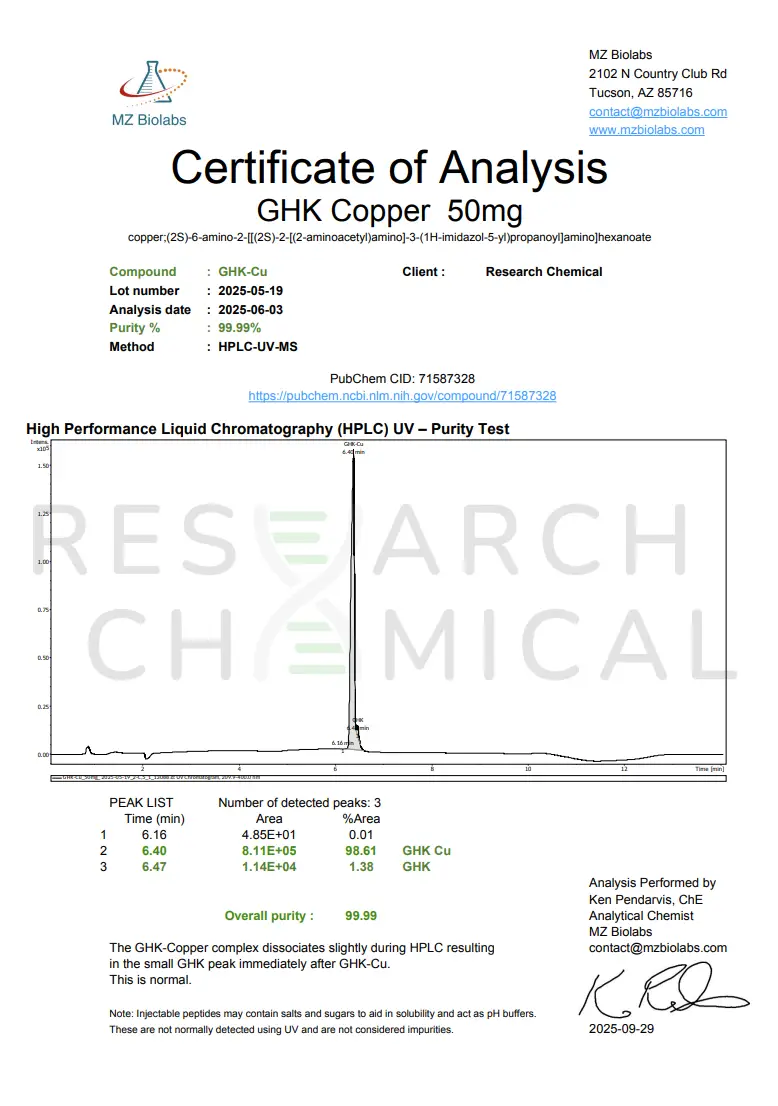
This item has been third-party tested by accredited U.S. laboratories and confirmed to meet a minimum purity of 98% through rigorous verification standards.
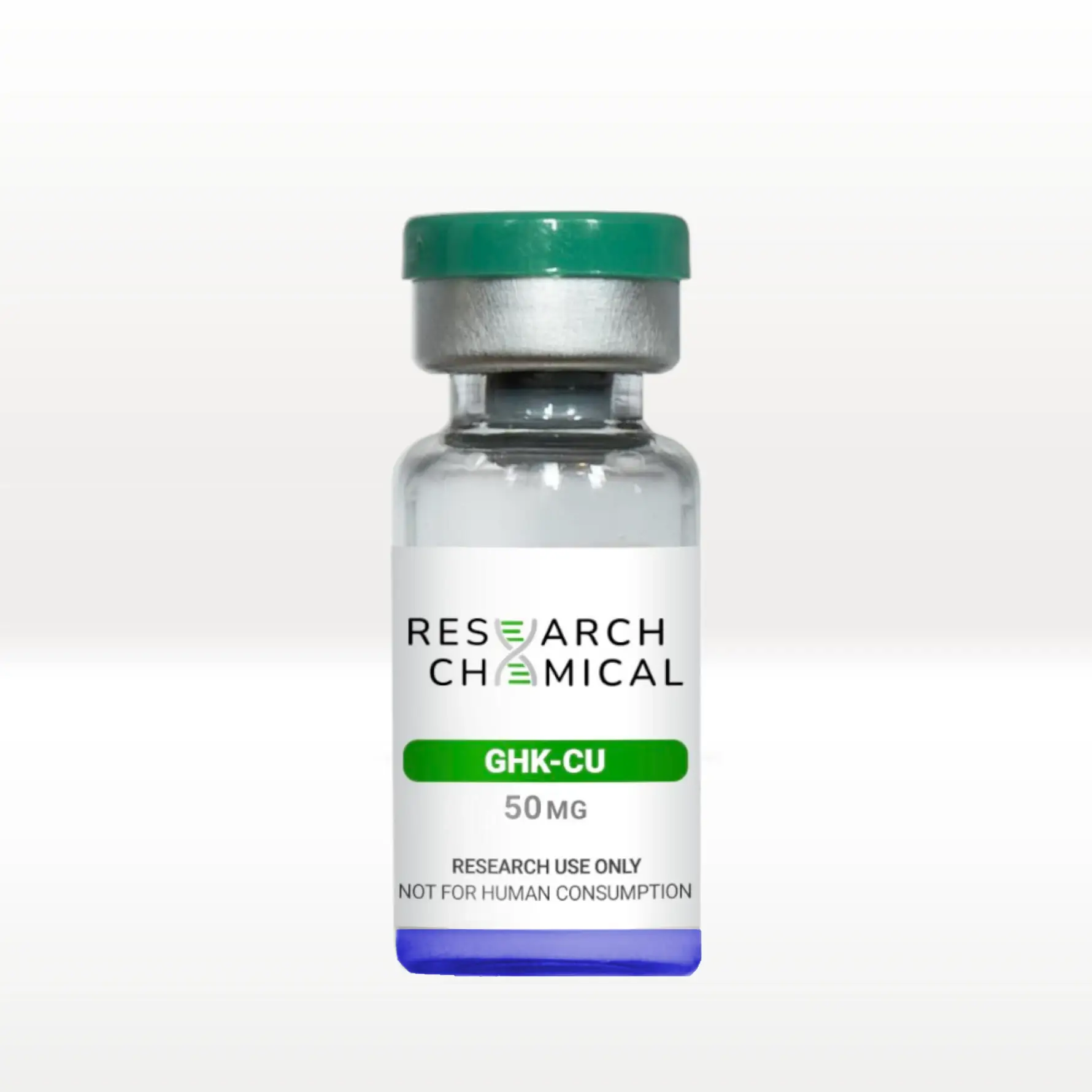
GHK-Cu is examined in research settings as a copper-complexed tripeptide, formed by the binding of copper(II) ions to the peptide sequence glycyl-L-histidyl-L-lysine. Research involving GHK-Cu focuses on copper transport mechanisms, peptide-metal coordination chemistry, and intracellular signaling pathways under controlled experimental conditions.
This compound is supplied exclusively for scientific and analytical research and is not intended for cosmetic, consumer, or clinical use.
$59.99
Copper Tripeptide (Gly-His-Lys–Cu²⁺)
GHK-Cu is a naturally occurring copper-binding tripeptide supplied exclusively for laboratory and analytical research purposes. This compound is studied in controlled research environments for its role in metal-peptide interactions, cellular signaling modulation, and gene expression research models.
Each batch of GHK-Cu is independently third-party tested to verify identity and purity, supporting accuracy and reproducibility in scientific research applications.
GHK-Cu is studied in laboratory and preclinical research environments to better understand how copper-binding peptides influence cellular signaling and regulatory pathways. Researchers examine this compound to explore:
Because copper plays a critical role in numerous enzymatic and signaling processes, GHK-Cu serves as a model compound for studying peptide-metal interactions in biological systems.
In experimental models, GHK-Cu functions through coordination of copper ions, allowing the peptide-metal complex to participate in intracellular signaling environments. Research focuses on how copper-bound peptides may influence transcriptional regulation, enzyme activity modulation, and cellular communication pathways.
These investigations are strictly mechanistic and exploratory, aimed at understanding peptide-metal dynamics rather than physiological or therapeutic outcomes.
GHK-Cu supplied by ResearchChemical.com is produced under controlled synthesis and chelation conditions to support compound integrity, purity, and reproducibility.
Manufacturing and verification standards include:
These measures ensure transparency and reliability for laboratory research use.
Laboratory supplies and dilution solutions are not included.
Research Chemical products are third-party tested by MZ Biolabs, an independent laboratory based in Arizona. Each batch is analyzed to ensure accuracy, purity, and that all specifications are met.
Store GHK-Cu in a cool, dry environment away from direct light. Refrigerate after reconstitution, if applicable, to maintain compound stability. Avoid repeated freeze-thaw cycles and follow standard laboratory handling protocols to prevent contamination or degradation.
By purchasing from ResearchChemical.com, you acknowledge that you are acquiring research chemicals intended solely for scientific investigation.
GHK-Cu is:
The information provided on this page is for educational and informational purposes only and should not be interpreted as medical advice. ResearchChemical.com assumes no liability for misuse, improper handling, or use outside of controlled research environments. It is the purchaser’s responsibility to ensure compliance with all applicable laws and regulations.
GHK-Cu is a naturally occurring peptide found in urine, serum, and saliva. Copper peptides are unique as they each have one or more copper ions attached to them to enhance their properties.
These peptides are being studied to promote skin healing and regeneration by stimulating collagen synthesis, enhancing skin health, and reducing rough skin appearance. Additionally, they have shown analgesic effects and potential benefits for nerve outgrowth and nervous system function in recent research.
GHK copper peptide is generally well-tolerated with minimal side effects reported. However, individuals with compromised immune systems or specific medical conditions should exercise caution and consult with a healthcare professional before signing up for laboratory research with copper peptides as these are research chemicals for research use only.
Yes, GHK copper peptide has been shown to increase hair growth in clinical studies by promoting hair follicle health and stimulating hair growth pathways.
The reported benefits of GHK copper peptide in recent research include skin healing and regeneration, increased hair growth, and potential anti-aging properties due to its role in stimulating collagen synthesis, extracellular matrix components, and reducing inflammatory molecules.
Lorem ipsum dolor sit amet, consectetur adipiscing elit. Ut elit tellus, luctus nec ullamcorper mattis, pulvinar dapibus leo.
Research Chemical products are third-party tested by MZ Biolabs, an independent laboratory based in Arizona. Each batch is analyzed to ensure accuracy, purity, and that all specifications are met.
By purchasing from ResearchChemical.com, you acknowledge that you are acquiring research chemicals intended solely for scientific investigation.
GHK-Cu is:
The information provided on this page is for educational and informational purposes only and should not be interpreted as medical advice. ResearchChemical.com assumes no liability for misuse, improper handling, or use outside of controlled research environments. It is the purchaser’s responsibility to ensure compliance with all applicable laws and regulations.
1. Bissett, D. L. (2005). Anti-aging skin care formulations. In Cosmetic formulation of skin care products (pp. 191-210). CRC Press.
2. Pickart, L., Vasquez-Soltero, J. M., & Margolina, A. (2015). GHK peptide as a natural modulator of multiple cellular pathways in skin regeneration. BioMed research international, 2015.
3. Pickart, L., & Margolina, A. (2018). Regenerative and protective actions of the GHK-Cu peptide in the light of the new gene data. International journal of molecular sciences, 19(7), 1987.
4. Pickart, L. (2008). The human tri-peptide GHK and tissue remodeling. Journal of Biomaterials Science, Polymer Edition, 19(8), 969-988.
5. Dou, Y., Lee, A., Zhu, L., Morton, J., & Ladiges, W. (2020). The potential of GHK as an anti-aging peptide. Aging pathobiology and therapeutics, 2(1), 58.
6. Anastassakis, K. (2022). Copper Tripeptides Copper tripeptides. In Androgenetic Alopecia From A to Z: Vol. 2 Drugs, Herbs, Nutrition and Supplements (pp. 225-230). Cham: Springer International Publishing.
7. Wang, X., Liu, B., Xu, Q., Sun, H., Shi, M., Wang, D., … & Feng, B. (2017). GHK‐Cu‐liposomes accelerate scald wound healing in mice by promoting cell proliferation and angiogenesis. Wound repair and regeneration, 25(2), 270-278.
8. Zhao, R., Chen, Y., Ma, Y., Zou, C., Zhang, J., & Chen, Z. (2022). Innovation and transformation of chronic airway diseases. Frontiers in Molecular Biosciences, 9, 1089813.
9. Lau, S. J., & Sarkar, B. (1981). The interaction of copper (II) and glycyl-L-histidyl-L-lysine, a growth-modulating tripeptide from plasma. Biochemical Journal, 199(3), 649-656.
10. Pickart L, et al. The human tri-peptide GHK-Cu in prevention of oxidative stress and degenerative conditions of aging: implications for cognitive health. Oxidative Medicine and Cellular Longevity. 2012; 2012: 324832. doi: 10.1155/2012/324832.
Please note that the above references provide evidence for the potential benefits of GHK-cu Peptide as stated in the product description. For more in-depth information, kindly refer to these scholarly works.
Join our insider list for the latest research insights, product releases, and special offers—delivered straight to your inbox.